
Your first driving lesson is coming up. You may be excited, nervous or unsure what to expect. You do not need to know how to drive before you arrive. A little preparation will help you feel more comfortable and make better use of your lesson.
This guide covers what to bring, what to wear, what you might learn and how to prepare for your next session.
First driving lesson checklist
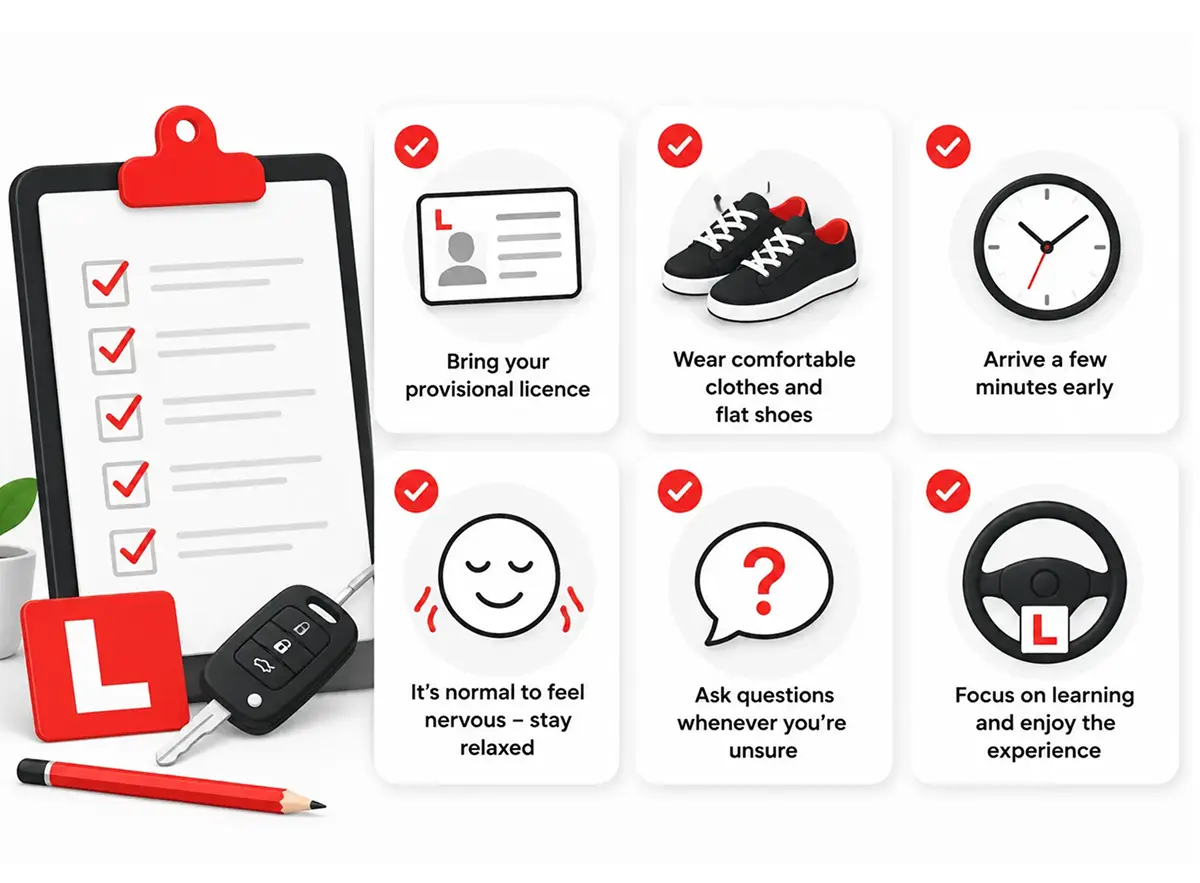
- Check your provisional driving licence. Make sure it is valid and have it ready for your instructor to check. Ask your instructor whether they need you to bring the physical card.
- Confirm your lesson details. Check the date, time, meeting point and whether you have booked a manual or automatic car.
- Wear comfortable, secure shoes. Flat shoes with thin, flexible soles can make it easier to feel the pedals. Avoid loose flip-flops or bulky footwear.
- Bring glasses or contact lenses if you need them. You must meet the legal eyesight standard for driving.
- Get a good night’s sleep. Arrive alert and allow enough time so you are not rushing.
- Bring questions. There is no need to memorise everything before the lesson.
Quick reminder: You normally need to be at least 17 to learn to drive a car on public roads in Great Britain, with some exceptions. You must have a valid provisional licence and be supervised. Check the official GOV.UK learning-to-drive rules if you are unsure.
What happens on your first driving lesson?
Every instructor and learner is different, so your first lesson may not follow exactly the same order. A complete beginner can usually expect an introduction to the car before any driving.
1. Meet your instructor and talk about your experience
Your instructor may ask whether you have driven before, whether you feel nervous and what you hope to achieve. Be open about your experience. If something worries you, say so before setting off.
2. Learn the cockpit drill
The cockpit drill is a set of checks to help you get ready to drive. Your instructor may show you how to adjust the seat, head restraint, steering position and mirrors, and how to check doors and seat belt. The aim is to sit comfortably and see clearly before moving.
3. Get familiar with the controls
You may explore the accelerator, brake, steering wheel, indicators, handbrake or parking brake, and gear selector. In a manual car, you will also learn about the clutch and gears. In an automatic car, there is no clutch pedal to operate.
4. Practise moving off and stopping, when appropriate
When your instructor decides it is safe, you might practise moving away smoothly, steering and bringing the car to a stop. Some learners spend longer getting comfortable with the controls first. That is normal. Your first lesson is not a test of how quickly you can drive.
5. Talk about your next step
At the end, ask what you did well and what you should focus on next. You can jot down two or three points while they are fresh in your mind.
What should you wear for a driving lesson?
Choose comfortable clothes that let you turn your head, move your arms and use the pedals freely. You do not need special driving clothes. Shoes matter more: something secure and comfortable with a reasonably thin sole can make pedal control easier. If you normally drive with glasses, wear them.
Feeling nervous before your first lesson?
It is common to feel anxious when you are doing something new. You might worry about stalling, making a mistake or being watched by other drivers. You are there to learn, not to demonstrate that you already know everything.
- Tell your instructor you are nervous so they can explain each step clearly.
- Ask them to repeat an instruction or demonstrate a control whenever you need.
- Focus on one action at a time rather than the whole driving test.
- Remember that making mistakes is part of learning. Your instructor is there to manage the lesson safely.
Do you need to pass your theory test before your first lesson?
No. You can begin professional driving lessons before passing the theory test, provided you meet the legal learner-driver requirements. It is still worth starting to read The Highway Code early. Understanding basic signs, road markings and priorities will help as your lessons progress.
Manual or automatic: does your first lesson change?
The basic preparation is much the same for both. In a manual car, your instructor will explain the clutch and gears as well as the other controls. In an automatic, you can concentrate on steering, braking, observation and the accelerator without operating a clutch pedal. Neither choice removes the need to learn safe observation, road positioning and decision-making.
What should you do after your first driving lesson?
Before you forget the details, write down what felt comfortable and what needs practice. You could review the controls you learned, read a few relevant Highway Code sections and plan your next lesson. Do not practise driving on public roads on your own. Any private practice must follow the legal rules for supervision, insurance and L plates. The DVSA Ready to Pass guide explains how to practise safely.
Frequently asked questions
Will I drive on the road in my first lesson?
Possibly. It depends on your experience, confidence, the location and your instructor’s safety judgement. You may start with an introduction to the car and basic controls.
Will I stall the car?
If you are learning in a manual car, stalling can happen while you get used to the clutch. It is a normal skill to practise. Automatic cars work differently and do not require you to operate a clutch.
How long should my first lesson be?
Lesson lengths vary by school and instructor. Smart Driving School offers a one-hour £29 Tester Lesson, which gives you a real lesson and a chance to experience an instructor’s teaching style before deciding whether to continue.
What if I do not feel comfortable with my instructor?
You should feel able to ask questions and explain what is not working for you. It is reasonable to consider a different instructor if their teaching style does not suit you.
Want to experience an instructor before booking more lessons?
Smart Driving School offers a £29 one-hour Tester Lesson in manual or automatic. You can meet the instructor, take a genuine lesson and decide whether you want to continue. If you prefer ongoing lessons, see our single driving lessons.
Have a question before you book? Message Smart Driving School on WhatsApp.